Über smartes.land

Diese Webseite entstand ursprünglich aus der Idee, mehr über Entwicklungsdynamiken und kreative Ansätze in ländlichen Räumen zu schreiben. smartes.land hatte dabei von Anfang an eine doppelte Bedeutung: „smart“ verstanden und verstehen wir bis heute als kreativ und nachhaltig, land bezog sich vorwiegend auf kleinstädtische und ländliche Räume. Einige der Beiträge auf dieser Seite greifen diesen ursprünglichen Kontext bis heute auf.

Mit der Zeit hat sich meine Interpretation von smartes.land zugleich verbreitert und auf nachhaltige und räumliche Wirtschaftsentwicklungen fokussiert.

smartes.land steht bei uns für eine systemische Perspektive auf Räume

Orte und Regionen sollten nicht isoliert betrachtet werden, sondern in Wechselwirkung mit den lebendigen Systemen, Verhaltensdynamiken, Menschen, Organisationen, komplexen Kooperations- und Wettbewerbsmustern aus denen sie heraus entstanden sind und sich kontinuierlich verändern. Diese Räume sind geprägt von Beziehungen, gegenseitigen Pfadabhängigkeiten, unterschiedlichen geschichtlichen Hintergründen und einer dementsprechend auch facettenreichen Anzahl von Problemlösungsansätzen.

„Context matters“ ist unser Mantra bei Mesopartner. Kopieren ist nicht möglich. Aber ein tieferer Blick in unterschiedliche Kontexte eröffnet die Möglichkeit, die eigene Welt mit neuen Augen zu sehen und darin neue Handlungsmöglichkeiten zu entdecken. Genau das ist auch das Ziel von smartesland. Hier teile ich meine internationalen, lokalen und systemischen Erfahrungen, Perspektiven, Methoden und Instrumente, um neue Blickwinkel zu eröffnen und Kolleginnen und Kollegen zu inspirieren.

„Über smartes.land“ weiterlesen

Reflections from the „Green Masterplan OWL“

From Thematic Green Agendas to Integrated Regional Strategies

Cities and regions are often described as the key implementation layer for green and economic transformation. But what does that actually mean in practice?

If we take this idea seriously, then place matters in a fundamental way. It is not only the location where policies are implemented, but the context that shapes what is possible—through its economic structures, its networks, its capabilities, and also its social dynamics.

For quite some time now, I have been looking for green regional strategies that take this seriously—approaches that are genuinely bottom-up and that combine the different layers needed to develop a region that is both competitive and oriented towards quality of life for its cities, SMEs, and communities.

What I was searching for was not another thematic strategy (such as a regional Circular Economy Strategy), but an approach that responds to the real complexity of challenges and opportunities a region faces.
In the following, I will share some observations from this search, as well as a first insightful case.

A dominant pattern: strong initiatives, but often thematic

Looking across the current landscape, many regional strategy initiatives have emerged in the context of the European Green Deal. Many of them have created important momentum. At the same time, they often follow a similar underlying logic:

  • Many of these initiatives are not primarily driven by bottom-up regional dynamics, but rather by predefined thematic priorities that are then translated into regional contexts.
  • There exists a wide range of platforms such as circular regions, circular cities, circular rural areas, climate-neutral cities, and energy cities, each of which focuses on a specific dimension of transformation (e.g. energy) or a specific target (net zero) within a place or territory, less so on the combination of the dimensions.
  • While these thematic approaches are valuable in creating focus and expertise, they often remain somewhat fragmented when seen from a regional development perspective.
  • In many cases, there is limited attention to how these themes overlap, interact, and need to be combined within a specific regional context in order to become effective.

What is often missing is a more integrated perspective that asks how different transformation agendas can be brought together in a coherent regional development pathway.

The challenge: moving from themes to regional systems

Regions are not organised along thematic lines. They evolve through the interaction of multiple elements: They are shaped by existing industries and clusters, which define starting points and transformation pathways. They are also shaped by networks between firms, knowledge institutions, and public actors, which enable coordination and collective action. Existing local capabilities and skills strongly determine how transformation processes can actually be absorbed and implemented.

The table above shows the overall Masterplan objectives with their vertical and horizontal combination of green themes.

Last but not least, people and organisations in a region are embedded in social and territorial dynamics that influence their willingness to participate, the feeling of belonging, and their capacity to act as drivers of transformation.

If green regional strategies remain within thematic silos, they risk missing these interdependencies.

What seems to be needed instead is an approach that:

  • Connects themes horizontally across sectors and policy fields, rather than treating them in isolation.
  • Links them vertically along value chains, competencies, and technological pathways.
  • Builds on the region’s specific strengths, experiences, and existing dynamics.

A different experience: the Green Masterplan OWL

Against this background, I recently came across the Green Masterplan OWL. What struck me was not a single innovative element, but the way in which different aspects are brought together into a more coherent approach.

Several elements seem particularly relevant.

  • The strategy is based on a strong bottom-up process, in which regional knowledge organisations and research institutes are not only involved as stakeholders, but actively contribute to building the analytical foundation, shaping methodologies, and designing monitoring approaches.
  • It builds on existing economic structures, especially long-standing cluster initiatives and regional networks, thereby anchoring reflection processes on green transformation requirements in established forms of cooperation and experience.
  • It combines different thematic areas both vertically and horizontally, for example by linking circular economy, bioeconomy, and waste along value chains, while at the same time connecting energy, mobility, industrial transformation, and skills across sectors.
  • It connects dimensions that are often treated separately, including competitiveness and future viability, learning and skills development, technological change, inclusion through education and participation, and clearly defined sustainability goals.
  • It makes use of participatory and implementation-oriented instruments, such as maturity models for assessing and monitoring regional progress, scenario processes with strong stakeholder involvement, the identification of pioneer actors, and a combination of lighthouse projects with smaller, quickly implementable initiatives that help to create momentum.

What emerges from this is not a collection of themes, but something closer to a systemic view of regional transformation.

The Regional Sustainability Maturity Model developed by the University of Paderborn classifies the different stages of progress that regions achieve in implementing their sustainable development strategies.

Towards more integrated regional transformation strategies

From my perspective, this is one of the first approaches I have seen that seriously attempts to move from thematic green initiatives towards more integrated, context-related regional transformation strategies.

What is relevant is that we treat the green transformation in regions and locations not simply as a set of topics, but as a systemic regional development challenge that requires coordination across multiple dimensions.

Questions I want to further explore

  • How can we move beyond thematic approaches towards more context-driven, integrated regional strategies that reflect the realities of specific places?
  • What other insightful international examples exist of implementation-oriented green regional strategies?
  • How are strategies such as the one in OWL actually implemented in practice? What challenges emerge on the ground, and what can be learned from them?
  • And what kinds of processes and instruments can we further explore and share to facilitate these transformations in a more participatory and agency-building way?

I will continue to explore cases in more detail over the coming weeks and would be very interested to hear about other examples and to exchange with others working on these questions.

Emotional Maps in Local and Regional Transformation Processes

Initial Reflections from Practice

In our work on local and regional transformation processes, we primarily focus on economic structures and the actors involved. This includes economic mappings of sectors, value chains, markets, support service providers, as well as actor mappings of organisations and their network relationships.

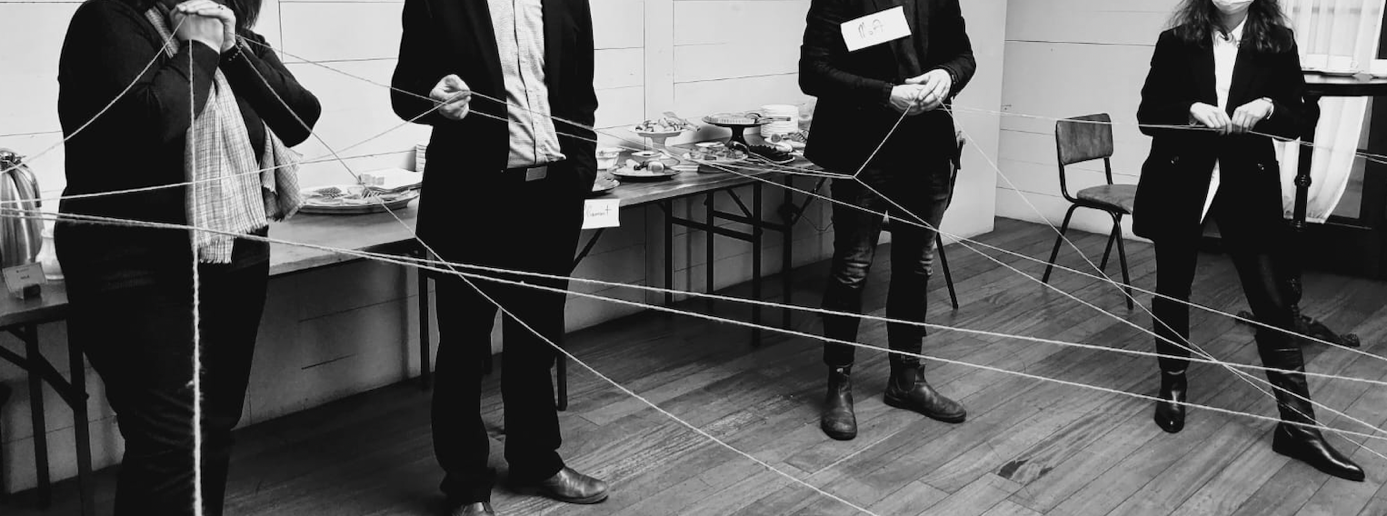
As part of a training seminar at the School of Participation, I had the opportunity to experience theatre-based methods and democratic systemic constellations. Both approaches aim to enhance the emotional perception and power-related considerations of systems, thereby enabling a deeper understanding (see LinkedIn posts and photos).

„Emotional Maps in Local and Regional Transformation Processes“ weiterlesen

Emotionale Landkarten in lokalen und regionalen Transformationsprozessen – erste Überlegungen aus der Praxis

In unserer Arbeit zu lokalen und regionalen Transformationsprozessen betrachten wir insbesondere die wirtschaftlichen Strukturen und die beteiligten Akteure. Hierzu zählen Ökonomie-Mappings mit den wirtschaftlichen Strukturen wie Sektoren, Wertschöpfungsketten, Märkten, Unterstützungsdienstleistern und Akteursmappings mit den Organisationen und ihren Netzwerkbeziehungen.

Im Rahmen eines Fortbildungsseminars der School of Participation hatte ich die Gelegenheit, theaterpädagogische Methoden und systemische Aufstellungen zu erleben. Beide Ansätze zielen darauf ab, Systeme und organisatorische Konstellationen stärker auf der emotionalen Ebene wahrzunehmen und dadurch ein tieferes Verständnis zu ermöglichen (siehe LinkedIn-Posts-Foto)

„Emotionale Landkarten in lokalen und regionalen Transformationsprozessen – erste Überlegungen aus der Praxis“ weiterlesen

Nicht Lösungsgeschwindigkeit, sondern Beziehungsqualität entscheidet über Transformationserfolge

Warum Gruppendynamiken und Resonanz für die Wirtschaftsförderung wichtig sind

Während meiner derzeitigen einjährigen Fortbildung im Bereich „Prozessbegleitung und demokratische Kommunikation“ (School of Participation) habe ich die Möglichkeit, neue Ansätze kennenzulernen und wertvolle Inputs zu erhalten. Ich frage mich, inwiefern diese Erkenntnisse unsere Praxis verändern könnten. Besonders zwei Themen regen mich bisher zum Nachdenken an: die Wissenschaft der Gruppendynamik und die Frage, wie resonante Beziehungen in Gruppen gestärkt werden können, sodass in Workshops und Arbeitsprozessen mit verschiedenen Akteuren eine Atmosphäre für lösungsorientierten Austausch entsteht.

Das Aufschreiben dieser Überlegungen ist für mich sowohl persönliche Reflexion als auch Anlass, unsere eigene Praxis neu zu betrachten: Wo können neue Ansätze integriert werden? Welche Fragestellungen ergeben sich daraus für unsere Arbeit?

Kooperation und Wettbewerb sind kein Widerspruch 

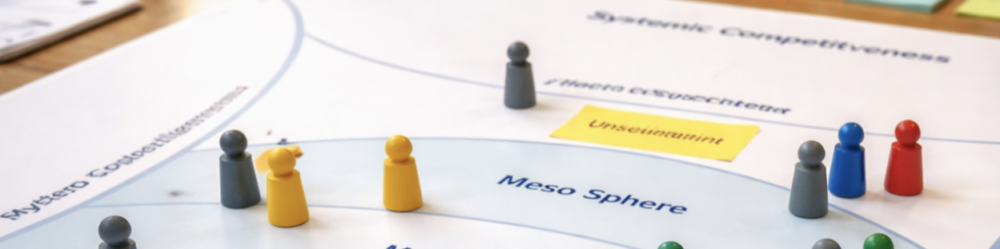
Wir verstehen bei Mesopartner unseren Bottom-up-Ansatz zur Wirtschaftsförderung als einen Prozess sozialen Wandels – verankert im Konzept der „Systemischen Wettbewerbsfähigkeit“. Dieses Rahmenkonzept hat unsere Denk- und Arbeitsweise stark geprägt. Seit unseren Anfängen betonen wir, dass sozialer Wandel ohne wirtschaftliche Entwicklung ebenso wenig tragfähig ist wie wirtschaftliche Entwicklung ohne soziale Einbettung und nachhaltige Strategien.

„Nicht Lösungsgeschwindigkeit, sondern Beziehungsqualität entscheidet über Transformationserfolge“ weiterlesen

What looks the same is not always as it seems

Experiencing the Historical Complexity and Human Context of Places and Regions

What looks the same is not always as it seems: one place, two different groups of stakeholders from two different economic sectors, two different realities. Despite cultural similarities, the same territorial framework conditions, and shared family roots and relations, the context can still be fundamentally different.

When working on economic development in territories and places, we tend to use the same tools, follow similar procedures, and structure our work in familiar patterns. Looking at photos from different work areas, an outsider might easily say: “This all looks the same!” Even I sometimes wonder, when browsing through documentations from previous years, whether we have not always experienced things in the same way. Whenever I reach that point, it is time to go back into the field. Then it becomes obvious again why I love this work—and why photos never capture what is truly relevant. As long as I stay open to genuine encounters and discoveries rather than mechanically ticking off steps, it is the human character of each place that keeps surprising me.

Locations and regions as „crystals of human life trajectories“

César Hidalgo coined the term “crystal of innovation” to describe products that embody accumulated knowledge from different generations or knowledge domains. I appreciate this crystal metaphor. And with the risk of sounding a bit philosophical, I believe every territory offers the chance to look into a crystal of human life shaped in that specific space—getting in touch with the historical paths of groups and local societies that, over long periods, have built their livelihoods and quality of life through their economic activities. It has been shaped by people staying and leaving, or coming back to these places, over generations. It provides a mirror of a continuous flow of life experiences, new ideas, and innovative ways of doing things, as well as the accumulation of new knowledge, but it may also reflect periods of stagnation, frustration, and a loss of direction. The economic structures of today are inextricably linked to people’s private lives, their thoughts, social bonding and bridging capabilities, and their aspirations. Trying not only to “understand” analytically but at the same time to sense the complexity that shapes each place can be truly enriching.

Elbistan Municipality

Experiences in South Turkey as examples of deep complexity, context-specific dynamics, and dense human and social fabrics and experiences

Over the past months, I have worked in several Turkish cities located in the regions affected by the 2023 earthquakes in southern Turkey — including Elbistan in Kahramanmaraş Province and Yayladağı in Hatay Province. More than 50,000 people lost their lives in this devastating disaster. Following the emergency response and initial recovery efforts, we are now promoting an opportunity-oriented economic development process to restore agency and reinvigorate local economic and income-generating activities.

I am grateful for the opportunity to look into these “crystals” again and again. They remind me that some places are going through disastrous phases of development, experiencing profound human and economic tragedies, while others are shaped by very different life experiences. Yet beneath these different trajectories, it becomes evident that every place, every context, is unique.

Even if photos from workshops and facilitation processes may look similar, the lived experience behind them is shaped by deep complexity, context-specific dynamics, and dense human and social fabrics rooted in long histories.

Driving Circular Economy in Upper Egypt: Insights from an UNIDO Program promoting Biowaste-made Products

Frank Wältring (Mesopartner) in conversation with Annachiara Scandone (UNIDO) , Project Leader of the Inclusive Green Growth Project Luxor and Qena governorates in Upper Egypt funded by SDC and the Italian Cooperation.

This written interview is a summarised version of the videocast and podcast:


Frank Wältring: Good morning, Annachiara. Nice to see you.

Annachiara Scandone: Good morning, Frank. Thanks for having me.

„Driving Circular Economy in Upper Egypt: Insights from an UNIDO Program promoting Biowaste-made Products“ weiterlesen

Equipping North Macedonia’s Steel Sector for EU Circular Economy Requirements

Frank Wältring (Mesopartner) in conversation with Kurt Wüthrich (Helvetas), Team Leader of the Program „Education for Employment in North Macedonia (E4E@mk)“ on the relevance and urgency of the circular economy topic from a business demand-oriented perspective.

This written interview is a summarised version of the available videocast and podcast:


Frank:
Thanks Kurt for your availability. We want to reflect on your experience with the Inclusive Green Economy approach—especially your integration of circular economy principles into your project. You’re based in North Macedonia and you’re the team leader of a project with Helvetas. Could you start by giving us a brief overview of the main focus of the project?

Kurt:
Thank you, Frank. Yes, we’re currently implementing a vocational skills development project for SDC. The project mainly focuses on two areas: First, we support long-term improvements in the formal education system. Second, we work on short-term solutions to meet the immediate needs of the private sector.

„Equipping North Macedonia’s Steel Sector for EU Circular Economy Requirements“ weiterlesen

Engaging Businesses in the Circular Economy and Strengthening System Redesigns

In my latest podcast episode, I sit down with Edward „Ned“ Clarence-Smith, a Circular Economy Expert with extensive private sector and international experience. He shares his insights on resource efficiency and sustainable business strategies. Tune in for a deep dive into the future of circular practices!

You can read the summarised essentials of the conversation below or listen to the podcast directly here or under this link.

In the early days, the primary focus was on minimizing industrial emissions and waste—essentially plugging the leaks in the system. The goal was to reduce damage rather than rethink the system itself. However, by the mid-1980s, people, particularly in industry, began questioning why so much time and money were being spent on damage control. Instead, the conversation shifted toward preventing waste and emissions at the source.“ (Ned Smith)

In this conversation, Frank Waeltring from Mesopartner has an engaging exchange with Ned Smith, who brings over 40 years of industry consulting experience. Ned’s career began with cost-benefit analysis, evolved toward resource efficiency, and most recently, focused on redesigning production systems— a key aspect of the circular economy.

„Engaging Businesses in the Circular Economy and Strengthening System Redesigns“ weiterlesen

Promoting Circular Territorial Development 

„Sustainable Future Cities, Towns and Communities“ (V)

“Circularity is not a trend; it’s a culture shift” (Ken Webster, 2017)

Looking at the inefficient and polluting way that energy is produced and used worldwide, it becomes apparent that we are still following the linear economic development model of “take, make, use, lose” (Raworth, 2017). In the local context, the social and environmental impacts of the linear economic model are particularly evident, namely the effects of climate change, ecological degradation and social exclusion.

„Promoting Circular Territorial Development “ weiterlesen